At ASEAN, Trump Pushes for Deals While China Seeks Free Trade
Diverging pressures from the United States and China at the ASEAN summit have led some member states to fear that the era of hedging is over.
By experts and staff
- Published
Experts
![]() By Joshua KurlantzickSenior Fellow for Southeast Asia and South Asia
By Joshua KurlantzickSenior Fellow for Southeast Asia and South Asia

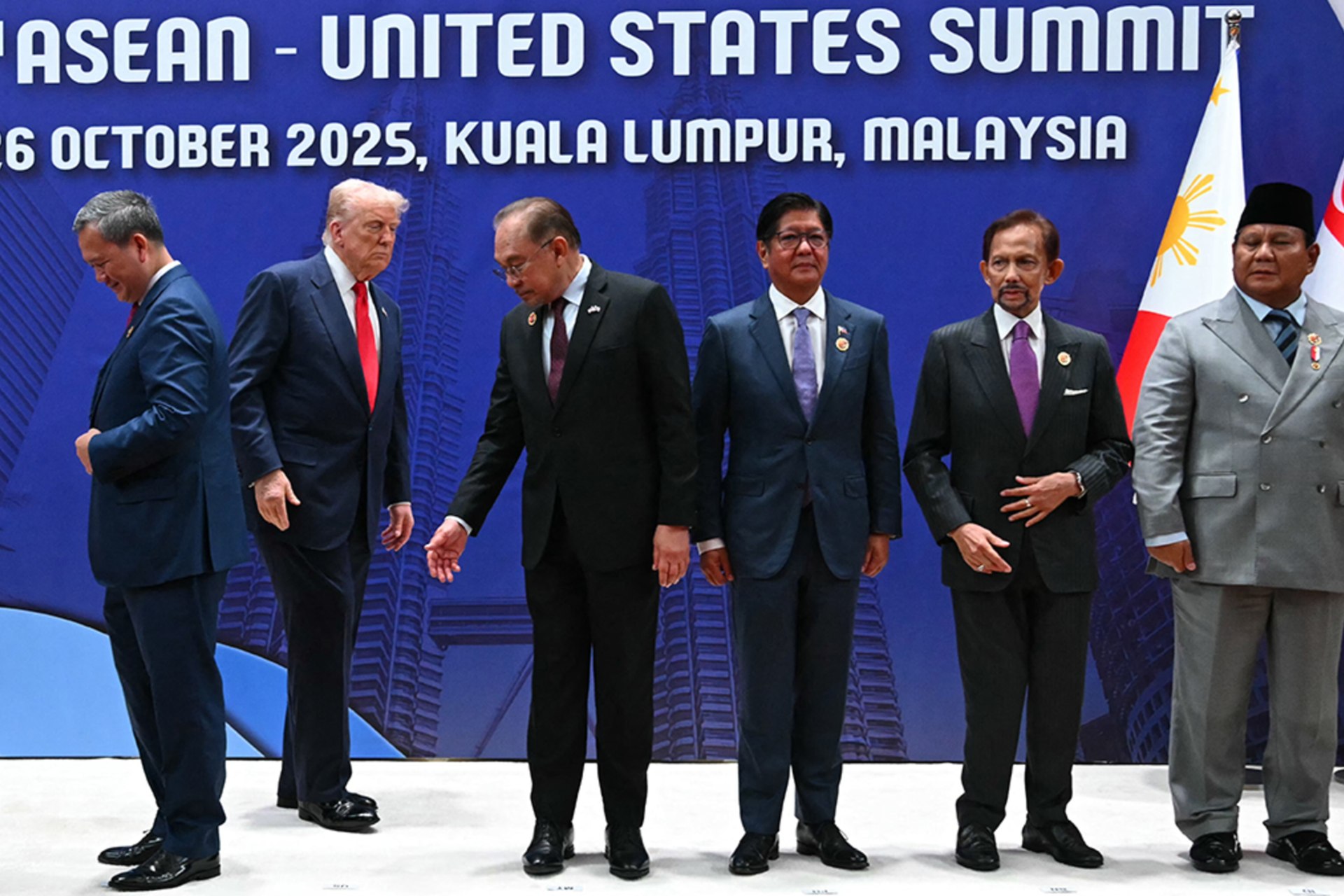
As President Donald Trump appeared at the annual ASEAN leaders summit, held this year in the organization’s chair Malaysia—the leadership of ASEAN rotates every year among the 10 (now 11 with Timor Leste acceding to the group) members—he embarked upon a flurry of activity with nearly half of ASEAN’s member-states. In just a few hours after landing in Malaysia, he had seemingly been everywhere.
In short order, the president made frameworks for multiple new trade deals that would go beyond existing limited agreements about tariffs with Southeast Asian states, oversaw the signing of a Cambodia-Thailand cease-fire, and met with a wide range of regional leaders. He promised that the United States is “100 percent” with Southeast Asia. He even sat down with Brazilian President Luiz Ignacio Lula da Silva, with whom he has had a poisonous relationship, in an attempt to reduce Brazilian tariffs on the United States and U.S. tariffs on Brazil. (He also agreed upon a new trade truce with China.)
With many of the ASEAN members, who are major exporters, the United States has significant leverage because they are highly dependent on the U.S. market. Yet at the same time, amidst this frenetic activity, the U.S. administration solidified some Southeast Asian states’ fears that the era of hedging between Washington and Beijing, by far the preferred strategy of ASEAN countries in a region dominated by giants, is definitively over.
As MSNBC noted: “At ASEAN, Trump announced individual trade agreements with four of its 11 member states, including Cambodia and Malaysia … [but] the Cambodia and Malaysia deals with the U.S. contained provisions obligating those countries to cooperate against ‘third countries’ in areas such as export controls and tariff evasion—language aimed at China.” Because Cambodia and Malaysia have now signed these deals, many of the other ASEAN states likely will feel they have to sign bilateral deals with the United States.
In the deals already struck, Malaysia and Cambodia promise to eliminate or sharply reduce tariffs on U.S. goods imports while the U.S. caps its tariff rate on Malaysian and Cambodian goods exports at 19 percent. The agreements also contain a range of provisions on nontariff barriers, services, and digital trade, among other issues.
Despite Malaysian leaders’ pragmatism in working with the United States, they will have a challenging task. Given that Malaysia has become, along with Thailand, one of the two large ASEAN economies with the closest links to Beijing, and that the Malaysian public has increasingly taken a more positive view of China than the United States, Kuala Lumpur will have an especially tough time in an era in which hedging is harder, if not impossible.
While the United States approached the summit one way, China took a different tack. At the summit, Chinese premier Li Qiang renewed a push for regional free trade, and publicly called on ASEAN leaders to reject what he called protectionism.
This is a term China increasingly uses in an attempt to brand U.S. policy as contrary to regional interests and to suggest China now is more dedicated to stability and economic institutions. “We must fully safeguard the hard-earned peace and stability in East Asia,” Li said at a meeting of ASEAN and dialogue partners. Japan, China and South Korea, according to Reuters. He advocated for regional states to “uphold free trade and the multilateral trading system, oppose all forms of protectionism, and continuously advance regional economic integration.”
The premier’s words do not exactly match with reality: China’s approach to regional waters, Taiwan, land boundaries, its own export controls, and other issues hardly safeguard peace and stability. But China is convinced that, today, it can sell itself as stable. Whether ASEAN states buy China’s sale depends both on whether Beijing acts in accordance with its statements, and on whether the White House’s warm words for ASEAN, and argument that despite the focus on tariffs U.S. - Southeast Asia trade deals help all parties, prove more appealing to regional states.